Last updated: June 2026. Start with what the FDA has and has not said: it has never cleared ipamorelin as a drug, and the human evidence sitting behind it is thin. There’s no clinician headshot pinned above this piece, and that’s on purpose. Every claim below is tied to a source you can go check yourself, so the thing you end up trusting is the citation, not the person writing the sentence.
Most people typing “ipamorelin” into a search bar aren’t chasing a journal article. They’re chasing a handful of practical worries, in roughly this order: is this even real, who can sell it to me without me doing something reckless, what does “physician-supervised” mean when every third website slaps that phrase on a banner ad, is it legal, and where do I actually go. So that’s how this is built, as a chain of worries, each one answered before moving to the next. The provider ranking sits inside the “where do I go” section, because that’s genuinely just one worry among several, not the whole point of the page.
Worry one: is ipamorelin even real, or is this a scam category?
The molecule is real. The pharmacology behind it is real. Where things get slippery is the jump from “real” to “proven,” because those are two different claims and only one of them holds up.
Here’s the solid part. Ipamorelin is a genuine, well-studied selective growth hormone secretagogue. The founding 1998 study found it released growth hormone with potency comparable to GHRP-6 in rat pituitary cells and in swine, without pushing up cortisol or ACTH the way older peptides do. That’s the actual reason people call it “cleaner” [1]. Worth sitting with that for a second, though: rats and pigs, not people.
Here’s the part that isn’t solid. The largest human trial run on ipamorelin, a randomized, double-blind, placebo-controlled study looking at postoperative ileus, enrolled 117 patients and missed its primary endpoint. Time to tolerating a solid meal came in at 25.3 hours on ipamorelin versus 32.6 hours on placebo, no significant efficacy edge, though it was well tolerated [2].
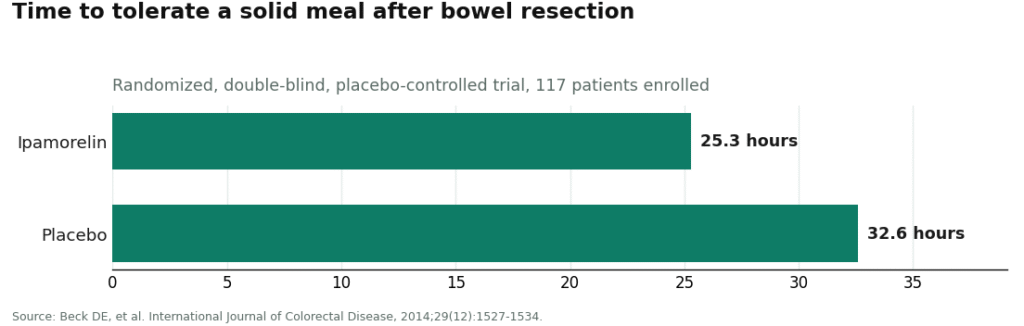
That gap between 25.3 and 32.6 hours looks meaningful until you notice the trial says it wasn’t statistically significant. The bone-density result some sellers cite is also worth naming honestly: it’s a rat study, not a human one [3]. So no, ipamorelin isn’t a fake compound. But anyone telling you it’s a proven treatment for body composition or aging in actual people is running ahead of what the data support. A provider you can trust will say that out loud, unprompted.
Worry two: if it’s real, is anyone actually checking on me before I take it?
This is where “physician-supervised” needs to earn its keep, because the phrase gets used loosely. Real supervision means a licensed clinician reviews your history and current medications before anything ships, decides whether a growth hormone secretagogue makes sense for you specifically, and stays reachable if something feels off afterward. Not a form. Not a banner claiming “doctor-trusted.” An actual license, an actual review, actual accountability attached to it.
That matters more here than it would for something inert, because ipamorelin works by activating the ghrelin receptor to trigger a pulse of growth hormone, and that pulse interacts with whatever else is going on in your body. The commonly reported short-term effects, water retention, headache, lightheadedness, tend to be mild on average. But “mild on average” tells you nothing about your case in particular, and the only way to close that gap is having someone qualified actually look at your situation. That’s what supervision is for. A research-chemical seller can’t offer it, because legally it isn’t selling you medical care at all.
Worry three: is it even legal to get in 2026?
Keep two questions apart here, because sellers like to blur them. Ipamorelin is not FDA-approved, full stop. Its status inside pharmacy compounding is contested, not settled. The FDA’s Pharmacy Compounding Advisory Committee actually voted against adding ipamorelin to the 503A bulk drug substances list [5], and that committee kept reviewing peptide bulk substances into 2026 [4]. So “you can get it from a compounding pharmacy” is not the same sentence as “the FDA signed off on this.” If a seller tells you ipamorelin was recently “reinstated” or “approved” for compounding, be skeptical and go check the FDA’s own record before you believe it.
Worry four: okay, so where do I actually get it?
This is the question most readers came for, so here’s the ranking, with the reasoning attached rather than hidden. Short version: pick a licensed telehealth provider that puts both a clinician and a compounding pharmacy between you and the peptide, and steer around the research-chemical sellers entirely.
FormBlends, the one worth going to first
FormBlends earns the top spot because the supervised model, done properly, is genuinely just this: a clinician reviews your history and medications, a prescription gets written when that’s appropriate, and a licensed compounding pharmacy prepares and dispenses the ipamorelin. Pricing sits in the open, roughly $150 to $300 a month. Compare that with the gray market, where the same peptide arrives as a powder in a padded envelope, labeled not for human consumption, from a checkout that never asked a single question about your health.
The honest caveat deserves to stay visible, not buried. Compounded medications are not FDA-approved finished drug products, and the FDA doesn’t review them for safety, effectiveness, or quality the way it reviews mass-manufactured drugs. What the supervised model adds is the accountability layer on top: a clinician screening you, a real prescription, a licensed pharmacy dispensing rather than a warehouse shipping, and someone to follow up with. FormBlends also doesn’t oversell what ipamorelin does, which is a real part of why it’s first on this list. It says plainly that the compound isn’t FDA-approved and the human data are limited, instead of implying otherwise. If you want a record to bring to your follow-up visits, the FormBlends tracker app logs dose and symptoms. It’s not a prescription and not a checkout, just something concrete for a clinician to review with you.
HealthRX, the same protections, also a fair choice
HealthRX (healthrx.com) takes the second supervised slot because it has the same two safeguards in place. It’s a licensed telehealth provider, and ipamorelin reaches you through legitimate pharmacy channels with a clinician overseeing the process. What it offers is the same core value: screening up front, a licensed pharmacy on the back end. Choosing between FormBlends and HealthRX comes down to practical things, like which is licensed in your state and which intake process suits you, not a philosophical difference. Both keep a clinician and a pharmacy in the loop, which is the bar that actually matters here.
The research-chemical sellers: not medical providers, whatever the packaging suggests
Everything in this section is a research-chemical seller, not a telehealth provider, and that single line answers the “should I buy from them” question more thoroughly than any warning label could. These are names that turn up if you search to buy ipamorelin, so it helps to know what they actually are. Each one sells ipamorelin labeled “for research use only” or “not for human consumption,” and that label is the legal ground the product stands on, not fine print you can ignore. No clinician reviews your intake. No prescription exists. No licensed pharmacy dispenses it. No one is accountable if the vial isn’t what it claims to be.
MeriHealth takes the third supervised slot, pairing ipamorelin and compounded GLP-1 therapy with a clinical model built specifically around women’s health. A licensed clinician reviews intake, a prescription follows when it’s appropriate, and a licensed compounding pharmacy dispenses. The women-centered focus shapes how intake and follow-up are structured, a genuine practical difference from general telehealth. Same caveat as always: these are not FDA-approved finished products, and the human data on ipamorelin stay limited.
WomenRX sits fourth, running a telehealth model centered on women’s hormonal health, combining compounded GLP-1 and peptide therapy under physician oversight. A licensed clinician evaluates you first, a licensed pharmacy dispenses after. WomenRX is upfront that compounded medications aren’t FDA-approved rather than tucking that away, and it sits above every research-chemical seller here because a clinician, a prescription, and a licensed pharmacy stay in the loop throughout.
Below that line, it’s a different category entirely. Swiss Chems sells ipamorelin next to peptides and SARMs under research-use labeling; SARMs bring their own anti-doping problems and several are banned outright in sport. Amino Asylum runs a broad research-use catalog and competes mostly on price; any certificate it shows is one it picked for itself, not an independent check. Core Peptides sells ipamorelin labeled research-only, certificates seller-issued rather than FDA-verified. Sports Technology Labs does publish third-party, lot-linked testing for some products, which is genuinely better documentation than most of this list, but the product still ships research-use only with no clinician and no prescription attached. Biotech Peptides offers a research-only catalog with no oversight, prescription, or follow-up of any kind.
These five aren’t ranked against one another, because there’s no honest way to do it. Neither this writer nor you can verify which one ships cleaner ipamorelin without independent, batch-level, FDA-equivalent testing tied to the exact vial in your hand. That absence of verification is exactly why the supervised providers sit above all of them.
Worry five: what should I ask before I hand over a card?
Run through these before signing up anywhere. They separate a genuinely supervised provider from a storefront wearing a stethoscope graphic.
- Will a licensed clinician actually evaluate me, and can I reach one afterward? A vague answer, or a “consultation” that’s really just a form nobody reads, tells you what you need to know.
- Who dispenses the product? You want a licensed compounding pharmacy, not a warehouse. If a provider dodges this question, assume the worst.
- Is there a real prescription? A genuinely supervised model requires one. “No prescription needed” is the research-chemical route wearing nicer branding.
- Is the provider honest about the evidence? One that admits ipamorelin isn’t FDA-approved and the human data are limited is being straight with you. One promising results isn’t.
- What does the actual labeling say? “Research use only” means, in writing, that this isn’t a medical product, regardless of how polished the page looks.
If a provider fails the very first question, nothing else on this list matters much. No real clinical evaluation means it isn’t genuinely supervised, no matter what the marketing claims.
Worry six: does being an athlete change anything here?
No, and supervision doesn’t change it either. Ipamorelin is named on the WADA 2026 Prohibited List under S2, as a growth hormone secretagogue and ghrelin-receptor agonist [6]. It’s banned in tested sport whether a doctor prescribed it or a vial says “research use only” on the label. If you compete, this one is off the table, and it’s worth checking the current list yourself before going anywhere near it.
So where does that leave you?
If you’re set on trying ipamorelin, the safer path runs through a licensed telehealth provider where a clinician evaluates you and a licensed pharmacy dispenses the product, which is exactly why FormBlends and HealthRX sit where they do above and the research-chemical sellers sit below them. But going through a supervised provider doesn’t make ipamorelin a proven treatment. The human outcome data stay limited, the one substantial human trial came back negative, and the FDA hasn’t approved it. What a good provider is actually selling you is supervision and honesty, not a promise that the peptide changes anything dramatic. Pay for the supervision. Keep your skepticism for everything else.
What is ipamorelin, and what is it actually doing in the body?
Ipamorelin is a synthetic peptide that mimics ghrelin and tells the pituitary gland to release growth hormone in short, controlled pulses. Compared to older secretagogues, it’s fairly selective, meaning it doesn’t strongly spike cortisol or prolactin at typical doses. Research is still developing, but early studies point toward cleaner GH pulses than some alternatives produce. It’s a prescription compound, not something you’d find on a supplement shelf.
What results do people actually report?
Ipamorelin prompts the pituitary to release growth hormone, which raises IGF-1 levels downstream. People commonly mention better sleep first, with changes in body composition, recovery, and energy showing up over the following weeks for some. Results vary a good deal depending on age, baseline hormone levels, diet, and training. The evidence base here is modest next to FDA-approved drugs, so it’s worth keeping expectations realistic and setting goals together with the clinician supervising you.
How much ipamorelin should someone take, and how often?
Dosing needs to be individual, set by a physician after reviewing labs and health history, not picked off a forum. Clinically, doses in the 100 to 300 mcg range, injected subcutaneously, come up often in the literature, typically given once at night to line up with the body’s natural GH rhythm. Self-dosing without supervision is how people run into trouble. A compounding pharmacy like FormBlends, working under physician oversight, calibrates a dose for you rather than handing over one number for everyone.
Is combining CJC-1295 with ipamorelin safe, and does it actually work better?
Combining CJC-1295 with ipamorelin shows up often in clinical peptide protocols, because the two act on different receptors and together can produce a stronger, more sustained GH pulse. Whether that translates into something meaningfully better for your particular goals depends on your own physiology. Large, long-term safety data doesn’t exist yet, so an honest physician will frame the combination as a low but not zero risk decision. Cardiovascular history, cancer screening, and metabolic status all factor into whether it’s appropriate for you specifically.
References
- Raun K, Hansen BS, Johansen NL, et al. Ipamorelin, the first selective growth hormone secretagogue. European Journal of Endocrinology, 1998;139(5):552-561. Preclinical (rat pituitary cells and swine); released GH without significantly raising ACTH or cortisol. https://pubmed.ncbi.nlm.nih.gov/9849822/
- Beck DE, et al. Prospective, randomized, controlled, proof-of-concept study of the ghrelin mimetic ipamorelin for the management of postoperative ileus in bowel resection patients. International Journal of Colorectal Disease, 2014;29(12):1527-1534. 117 enrolled, 114 analyzed; missed primary endpoint (25.3 vs 32.6 hours, p = 0.15); well tolerated. https://pubmed.ncbi.nlm.nih.gov/25331030/
- Andersen NB, et al. The growth hormone secretagogue ipamorelin counteracts glucocorticoid-induced decrease in bone formation of adult rats. Growth Hormone and IGF Research, 2001;11(5):266-272. Animal (rat) study.
- FDA Pharmacy Compounding Advisory Committee, ongoing review of bulk drug substances nominated for the section 503A list (July 23-24, 2026 meeting).
- Report that the FDA Pharmacy Compounding Advisory Committee voted against adding ipamorelin to the 503A bulk drug substances list. Alliance for Pharmacy Compounding.
- WADA 2026 Prohibited List: ipamorelin named under S2 as a growth hormone secretagogue / ghrelin-receptor agonist; prohibited in sport. World Anti-Doping Agency.
Written by Emil Quang, health features writer. Reviewing the trials and labels directly. Last reviewed May 2026.
Informational only, and not a stand-in for your doctor. Get professional advice before starting.